Content strategy 101: Get organized and maximize your website's potential with a Content Matrix!
There's a difference between writing content just for the sake of output and writing content to engage with your audience.
Social media and the internet are great places to build an online presence. Whether you're a business or an individual influencer, creating some sort of online portfolio is a must during these times.
However, you may find yourself a bit overwhelmed by the amount of information or content you want to put out. You may find yourself stressed out that your content just doesn't seem right. For you, it may seem like it lacks coherence or passion. Either way, you're just stuck.
Well, here's where great content strategy comes in. The whole process of creating a content matrix may seem daunting at first but we're here to help you through the process.

What is a Content Matrix?
A content matrix is a content planning tool. This is used to plan, organize, and track the content for a website. A lot of planning and thinking goes into doing a content matrix, so this isn't something done overnight.
A content matrix helps to ensure that all pages of a website have consistent messaging and branding.
The content matrix typically includes:
- Important information such as page titles, topics covered on each page
- Keywords associated with each page
- The target audience for each page
- Calls-to-action (CTAs) on each page
- Any other relevant information related to the content of the website.
Content matrices can also be used to help create an editorial calendar by mapping out when certain pieces of content should be published or updated.
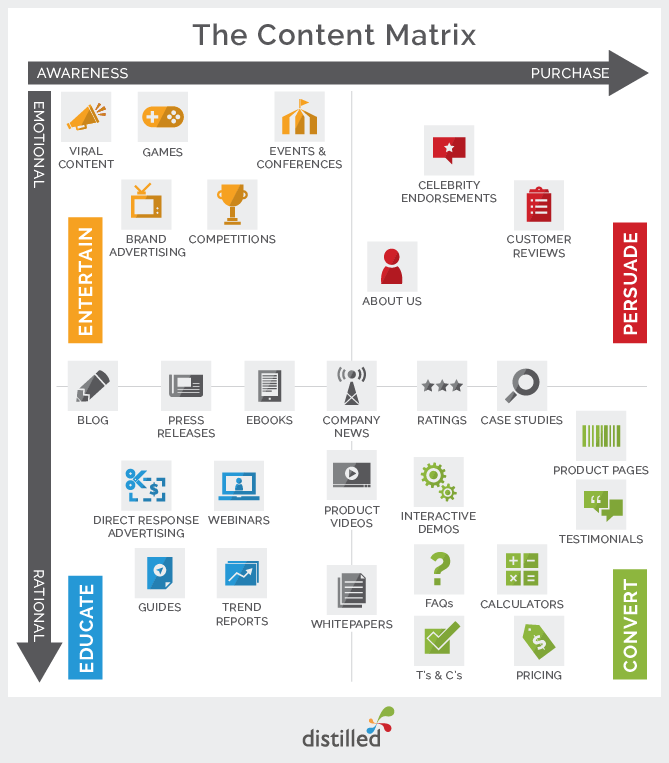
There are four concepts that we need to understand when we start planning our content matrix.
- Awareness. First of all, it's important to make your presence known. In these times, it's easy to advertise your website or business out there since the internet is free. You can aim to make viral content that will surely stick with your audience. Aside from that, promotions from other platforms such as events, conferences, competitions, and even popular media such as games can help in an exposure.
- Emotional connection. Content is not enough. There should be a goal to evoke your viewer's emotions by producing relatable content!
- Rational advertising. At the same time, the content in itself should make sense and it should be rational.
- Purchase. Finally, our last goal is to be able to persuade our audience to avail of our products or services. Are they convinced by the content we put out? These can be achieved by incorporating identity into our content. Other ways could also be from other factors such as endorsements and customer reviews.
When these concepts are well-executed, here are the main goals that an efficient content matrix must produce:
- To entertain. For the most part, content needs to be entertaining. Nobody wants to consume content that won't pique any interest.
- To educate. Content without substance is useless. Any form of content should have information ready that can benefit your ventures.
- To convert. With great information and entertaining prose, effective content should be able to change the mind of the audience.
- To persuade. Efficient content should be able to persuade your audience to avail of products or services.
Now that we have the basics must-dos in content strategy, let's get into the step-by-step guide on how to get this going!

A step by step guide on how to create a content strategy
1. Research Your Audience
To be able to entertain, educate, convert, and persuade, you must be able to know what exactly piques your audience's interest. Different groups of people require different forms of strategies. There's no cookie-cutter approach!
2. Developing your Brand
Here's where more of the technical parts come in. You must know the ins and outs of your branding. Some of the basic things you must get into consideration are:
- What are your brand's signature colors and looks?
- What are your brand's visions and missions?
- What does your brand stand for?
- What are your advocacies?
- What are your quirks and uniqueness?
These are all important factors to consider when you're trying to make cohesive and rational content. Making your branding statement is important. You'd want something that will remind people about "you"!
3. Inventing Ideas and Planning
Your content matrix will play a huge role in this step. When you've finally established your brand identity, it's time to start organizing how you're going to put these ideas into the world. This is where you can plot out every tiny detail that comes into mind and organize it so you can make something grand.
A content matrix can help to make sure that everything ties in together into one big picture. The ultimate goal is to be able to incorporate those main concepts (awareness, emotional, rational, and purchase) to attain the desired outcome (to entertain, to educate, to convert, and to persuade).
4. Setting Your Goals
Let's talk specifics. What are your main goals? For example, your goal is to be able to produce much content per week so you can boost sales or to generate leads. Setting your goals can help you plan the trajectory of your content matrix.
5. Launching
Now that your content matrix has been thought out and planned, it's now all a matter of how you will be pacing the information you will be putting out. Usually, a brand will hype up a launch and then schedule its following content evenly.
What are the different types of content materials?
Don't know what to post? Well, here's a guide on which content materials are best to use in your brand.
- Blog posts
- Infographics
- Articles
- Emails
- Videos
- Testimonials
- Case Studies
These are fool-proof ways that can ensure that you're getting your content out there. What's great with these is that they all can be put on one page or website. With this accessibility, people are more likely to be able to know more about your branding.

Final takeaway: How does a content matrix help plan, organize, and track website content?
Taking one's time and effort to build a content marketing matrix will surely benefit you in the long run. It can give a clear picture of where your brand is headed in terms of your goals and your leads.
Relatability to your audience and the drive to keep them interested is just one of the hurdles you need to face when you're constantly generating content for marketing. So, taking your time to plan one with your team will surely benefit the future of your brand.